


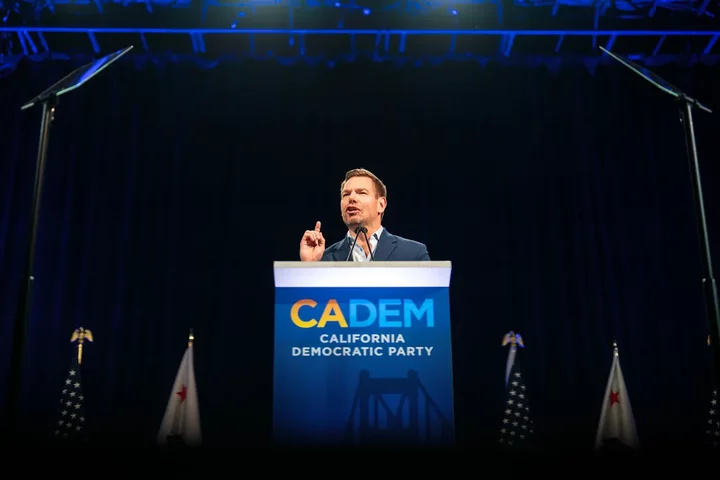
As California’s gubernatorial race heats up, a crowded field of nine Democratic candidates is competing to replace Governor Gavin Newsom, and party delegates are struggling to make sense of the options. The California Democratic Party’s convention last weekend offered the perfect stage for candidates to vie for support. Some, like billionaire investor Tom Steyer, advocated higher taxes on the wealthy, while others, such as Rep. Eric Swalwell, emphasized the state’s critical role in resisting federal threats, including Donald Trump and Immigration and Customs Enforcement (ICE).
The event, held in San Francisco, was not expected to result in an endorsement, which requires support from 60% of the 3,500 delegates. In the preliminary endorsement results, Swalwell led with 24%, followed closely by former state Controller Betty Yee and former state Attorney General Xavier Becerra. While these results reflect the opinions of the state’s most active Democrats, they do not mirror the preferences of likely voters, where Yee and Becerra lag behind with 2% and 3.5% support, respectively.
For the candidates, the convention was an essential opportunity to connect with labor unions, activists, and delegates—key figures who can galvanize grassroots support, fundraise, and mobilize voters. Former Congresswoman Katie Porter, in her signature neon-pink blazer, joked about her unique ability to juggle being a single mother of three teenagers while running for governor. Her proposal to eliminate state income taxes for households earning less than $100,000 caught attention, especially with the endorsement of Massachusetts Senator Elizabeth Warren.
Tom Steyer, known for his deep pockets and climate activism, sought to strengthen his position among the party’s left-wing factions. Steyer’s substantial TV ad campaign, backed by a $30 million personal investment, has made him a prominent figure, though his entry into the race has drawn scrutiny due to his wealth and lack of political office experience.
Meanwhile, Swalwell, who is positioning himself as a staunch anti-Trump voice, used his appearance at the labor caucus to highlight his role in the impeachment of former President Donald Trump. His outreach to younger, progressive voters was evident at a pop-culture-themed party featuring the pop duo Aly & AJ, catering to millennials who grew up on Disney Channel.
Despite the star-studded appearances and numerous proposals, many delegates expressed frustration with the large pool of candidates. With only two weeks left before the June primary deadline, the party faces a dilemma. A fragmented race could split support and increase the chances of two Republican candidates making it onto the November ballot—a scenario that has party members deeply concerned. Polls indicate that conservative candidates like former Fox News host Steve Hilton and Riverside County Sheriff Chad Bianco could defeat many of the current Democratic contenders.
Porter, who has garnered attention for raising concerns about a potential “lockout” of Democratic candidates, argued that party members must take the situation seriously. Yet, while all candidates acknowledge the importance of narrowing the field, none have directly called for anyone to drop out. Porter herself emphasized that she would exit the race if her polling numbers dropped, though she currently remains optimistic about her standing.
Candidates like Yee and Becerra, who have consistently polled poorly, are fighting to maintain relevance. Yee, in particular, has focused on her extensive experience with the state’s budget and fiscal matters, acknowledging California’s ongoing deficit as a significant challenge. Despite lagging behind, Yee remains determined, with a spokesperson stating, “Don’t underestimate the power of grassroots.”
The issue of money is also becoming increasingly complicated. Steyer’s wealth has allowed him to blanket the airwaves with campaign ads, positioning him as a progressive billionaire. However, his wealth has raised uncomfortable questions within the party, especially regarding economic inequality and the influence of money in politics. Some of his critics, like Porter, argue that candidates must be able to connect with everyday people, not just wealthy donors.
Steyer’s approach to addressing wealth inequality has resonated with certain left-wing constituencies, including the California Nurses Association. Still, the backlash from more grassroots Democrats is palpable, with Yee calling the influx of billionaire money a test of whether the party can still support grassroots campaigns.
San Jose Mayor Matt Mahan, a centrist candidate, has also gained attention for his handling of homelessness in his city, where he introduced innovative solutions like tiny homes for the homeless, though some argue his approach leans too heavily on law enforcement. Mahan’s fundraising has been bolstered by contributions from Silicon Valley tech executives, leading to criticism that his campaign caters to wealthy interests.
As the field narrows and the primary approaches, California Democrats face tough choices. With candidates ranging from the left-wing activists to centrist moderates, the party is grappling with how to consolidate support and avoid a split vote. While several candidates have enjoyed backing from prominent groups, the race is far from decided, and many Democrats are uncertain about how the field will ultimately shake out.
The coming weeks will be crucial as candidates vie for voters’ attention, hoping to secure their place in what is shaping up to be a fiercely competitive primary season. Whether California Democrats can find consensus and avoid the looming threat of a Republican surge remains to be seen.
