


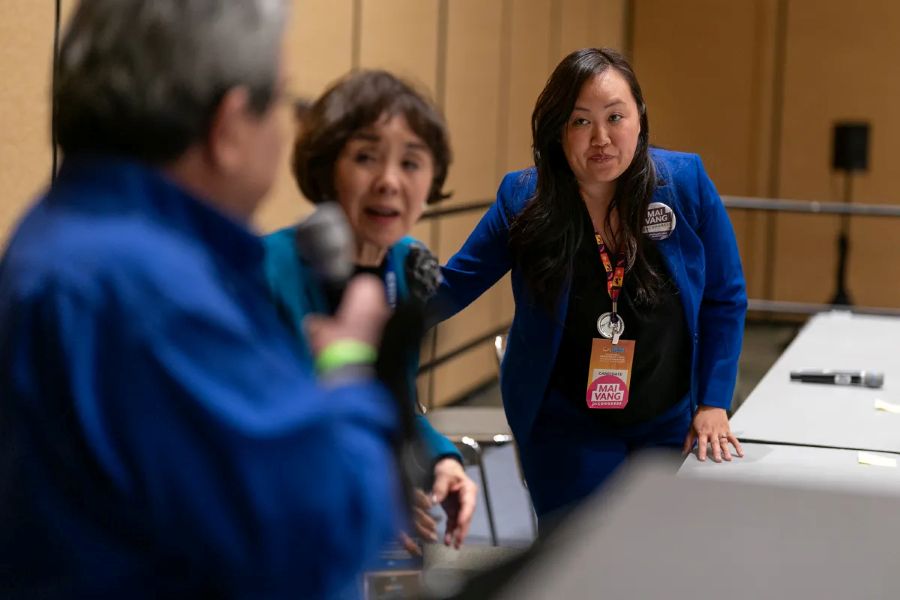
At the California Democratic Party’s annual convention, a clear divide emerged between party insiders and the progressive voices pushing for change. With the 2022 midterm elections looming, the state’s largest Democratic organization has opted to back veteran incumbents, signaling a preference for stability over radical shifts in leadership.
Rep. Mike Thompson, 74, who is seeking his 15th term, and Rep. Brad Sherman, 71, aiming for a 16th term, were among the aging incumbents who secured the party’s endorsement without major opposition. The California Democratic Party also endorsed state Sen. Mike McGuire in the race to replace the late Republican Rep. Doug LaMalfa, who represented northern California for over 13 years.
Despite the lack of surprise, the endorsements left many grassroots candidates and political outsiders feeling disillusioned, especially those pushing for new leadership and policies to address growing concerns within the party. Mai Vang, a progressive Sacramento city councilmember and the first elected official to challenge Rep. Doris Matsui in 20 years, voiced frustration, pointing to the party’s reliance on familiar, establishment figures.
Vang, who contested the 7th Congressional District seat, was particularly disheartened by the involvement of Speaker Emerita Nancy Pelosi, who wasn’t a delegate for the district but gave a speech supporting Matsui. Vang argued that the party’s endorsement process had been unfairly skewed in favor of incumbents and out of touch with the progressive push for change.
Jake Levine, a former Biden White House aide running against Sherman, echoed similar sentiments, stressing the need for a new generation of leaders to address issues that matter to younger voters. “We cannot keep relying on the same anti-Trump rhetoric without presenting a clear vision for the future,” Levine said, urging the party to evolve beyond past strategies.
The convention also marked a significant moment for House Speaker Nancy Pelosi, who announced she would retire after her current term. Pelosi’s legacy, marked by significant influence in shaping Democratic leadership, was acknowledged by party members who lauded her efforts in cultivating future leaders, including Sen. Adam Schiff. Schiff’s impassioned speech at the convention illustrated the intense frustration with the Trump administration, but for some, it highlighted the party’s struggle to focus on long-term leadership rather than just reacting to external threats.
Despite the concerns voiced by some delegates, the establishment wing of the party defended its choice to back familiar faces. Rep. Zoe Lofgren, chair of California’s Democratic congressional caucus, argued that now was not the time to introduce entirely new lawmakers. “We need people who know what they’re doing, especially as we confront a second Trump administration,” Lofgren stated, emphasizing the need for seasoned politicians during these volatile times.
However, critics like Levine warned that a failure to prioritize younger voices would risk further alienating voters, particularly those under 40, who have expressed dissatisfaction with the status quo. The party’s deep reliance on seniority, they argued, limits its ability to adapt to the needs of a new generation.
One potential breakthrough for progressives emerged in the race for the 22nd Congressional District. Assemblymember Jasmeet Bains, widely considered the frontrunner, failed to secure the party’s endorsement despite major backing from unions and political figures. Her opponent, Randy Villegas, a professor from Visalia, managed to generate significant grassroots support, raising more funds and creating a groundswell of enthusiasm among delegates. However, the party chose not to endorse a candidate in this contested race, reflecting the complexity of the situation.
Villegas claimed that some delegates were intimidated into supporting Bains, an allegation Bains denied, calling the accusations baseless. This internal tension highlights the ongoing struggle within the Democratic Party between its establishment wing and more progressive elements eager to reshape its future direction.
As the midterm elections approach, the party faces a crucial moment in its evolution. The question remains whether it will continue to lean on established leadership or embrace the call for change from within its own ranks. As California Democrats prepare for the upcoming primary season, the party’s ability to unify behind a clear vision will determine its success in flipping the U.S. House and shaping the political future of the state.
